
Law & Compliance / Explore
Law & Compliance / Explore
AI Liability and Sanctions
The AI Act is not the whole story. A comparative program on who can be sanctioned, by whom and under which rules when an AI system causes harm, across the European Union and its member states, for legal departments, compliance functions and law firms.

01 / The Solution
The EU AI Act sets administrative fines of up to 35 million euros or 7% of worldwide annual turnover, whichever is higher, and leaves the rest to the member states: who enforces, how proceedings run, which national fines are added, and whether a breach is also a crime. Around it sit the GDPR, the Digital Services Act, the Data Act, NIS2, the Cyber Resilience Act, the revised Product Liability Directive and consumer law, each with its own sanctions and its own authority.
Italy has gone furthest. Law 132/2025 and Legislative Decrees 160/2026 and 179/2026 make the omission of security and human-oversight measures on high-risk systems a criminal offense (art. 437-bis of the Criminal Code), punish the unlawful dissemination of AI-generated or manipulated content (art. 612-quater), add both to the predicate crimes under Legislative Decree 231/2001 (art. 25-vicies, with fines up to 1,000 quotas and disqualification), introduce civil rules on disclosure, presumption of causation and direct action against the insurer, and entrust supervision to AgID and ACN with a fourth fine tier. Germany adds national fines of up to 50,000 euros under the KI-MIG, in force since July 2026, and has a deepfake offense before Parliament. In Spain AESIA is operational, while the organic law bill lapsed with the dissolution of the Cortes. France, the Netherlands and the Nordic countries follow their own routes. The same deployment therefore carries a different liability profile in each member state.
The program maps the five layers together, in short live modules each organization composes to its needs. The EU layer: the AI Act’s own sanctions, who answers along the value chain, data protection and automated decisions, product liability and civil claims, cybersecurity, platforms and consumers. The national layer: one module per member state, Italy, Germany, Spain, France, the Netherlands and the Nordic approach ready, cross-border deployment, and all 27 member states on request with local counsel. The cross-cutting modules: liability versus accountability, regulatory entropy and the compliance model, human oversight as a legal duty. Practice labs on the e-REAL platform, with conversational AI avatars: map the exposure, update the compliance model, answer the authority and then the court.
Every path runs entirely online, entirely onsite, or online with an onsite launch or closing event. Sessions last 90 to 120 minutes, with at most 16 participants. English throughout; national modules in Italian, German, Spanish, French, Portuguese, Greek or Dutch where indicated; avatars in the simulations speak more than 40 languages. When a regulation changes, the module is revised and an update session is scheduled. Paths of four modules or more lead to a Certificate of Completion issued by Logosnet, a member of the Pact for Skills, stating the hours completed. Built on Fernando Salvetti’s book Generative Artificial Intelligence and the Future of Law (Springer, in press).
02 / How It Works
01
Compose the path
Every path starts with EU-01 (the AI Act’s own sanctions), EU-02 (who answers along the value chain), CC-01 (liability versus accountability) and NA-EU (cross-border deployment). With your organization we add the EU modules that fit, the national modules for the member states you operate in, the cross-cutting modules and the labs for your roles. Paths run from four to about twelve modules, 8 to 18 hours, over a quarter.
02
Learn the map
Live sessions of 90 to 120 minutes, one a week, online or onsite. Each national module is taught by a practicing lawyer in that member state, on the law as it stands at the date of delivery; bills before parliaments are marked as such in class. Materials, the liability map and recordings stay on the e-REAL platform.
03
Practice in the labs
Simulated cases with conversational AI avatars. A client group deploys one AI system in three member states and participants map administrative, criminal, corporate and civil exposure per country, identify the authorities and decide where the evidence sits, with an avatar board asking for a one-page answer. In the Italian case, participants map the systems, identify the high-risk ones, assign oversight roles and update the Decree 231/2001 model and the code of ethics, with an avatar supervisory board asking what evidence exists. After an incident, an information request from a market-surveillance authority arrives, then a civil claim: participants reconstruct the documentation, decide what to disclose and draft the response, with an avatar inspector and an avatar opposing counsel asking the follow-up questions.
04
Defend and repeat
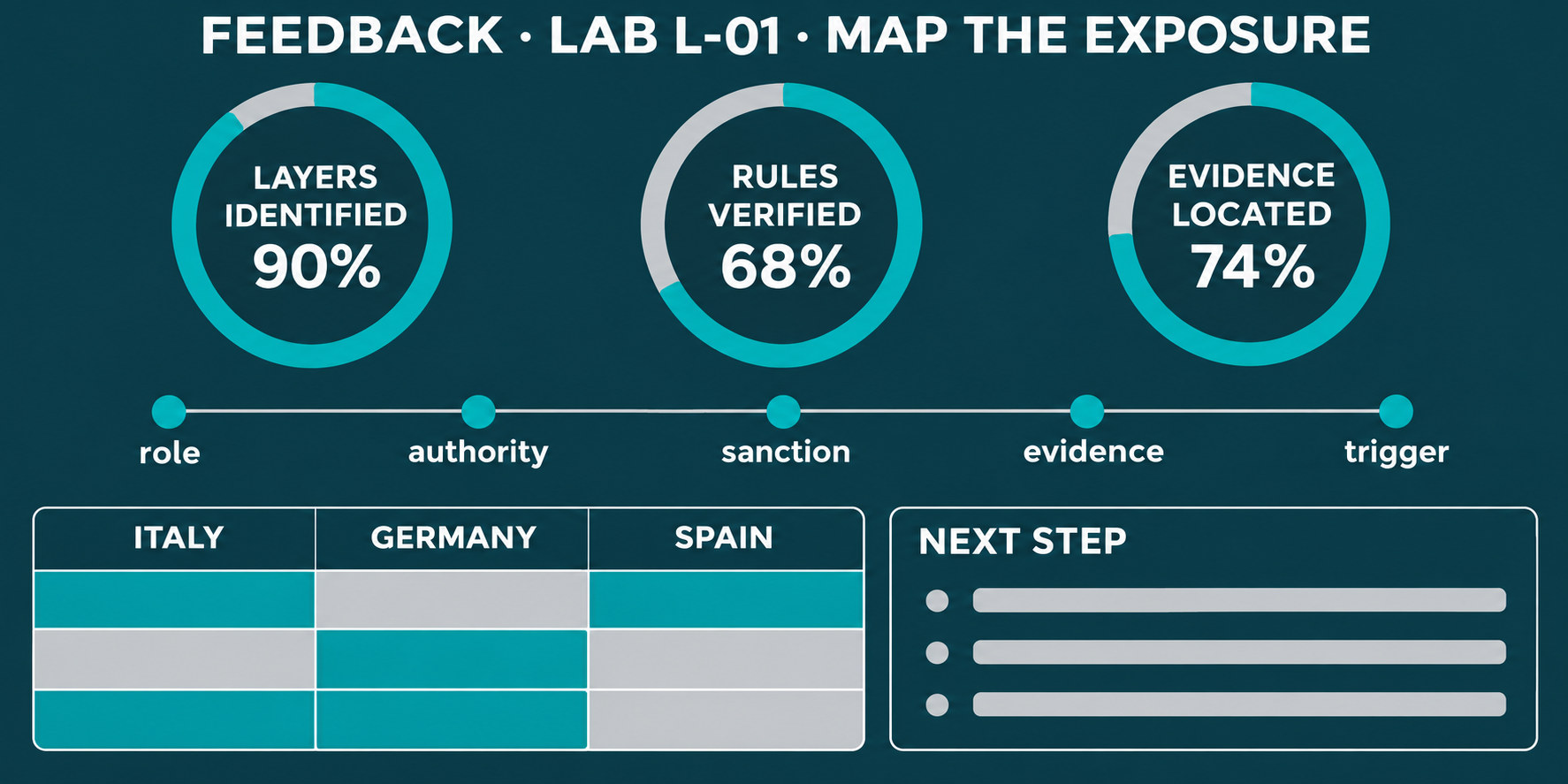
Feedback after each lab connects every decision to the rule it rests on and to the evidence behind it: liability layers and roles correctly identified, the state of each rule actually checked, completeness of the exposure map, quality of the evidence, clarity of the answer for a board and for an authority, residual risk stated with triggers for review. When a regulation changes, the module is revised and participants of previous editions are invited to the update session.
Example
Map the exposure (Lab L-01)
One system, three countries, one incident. The feedback dashboard shows layers identified, rules verified and evidence located, country by country, and lists the next steps the participants committed to before the avatar board.