
Culture, Tourism & Experiences / Explore
Culture, Tourism & Experiences / Explore
MirrorMe
The collection stays behind glass. The visitor steps in.
01 / The Solution
A costume on a mannequin shows a shape, never a body in motion. A label says what the object is; it does not say how it was worn, how much it weighed, what it asked of the body inside it.
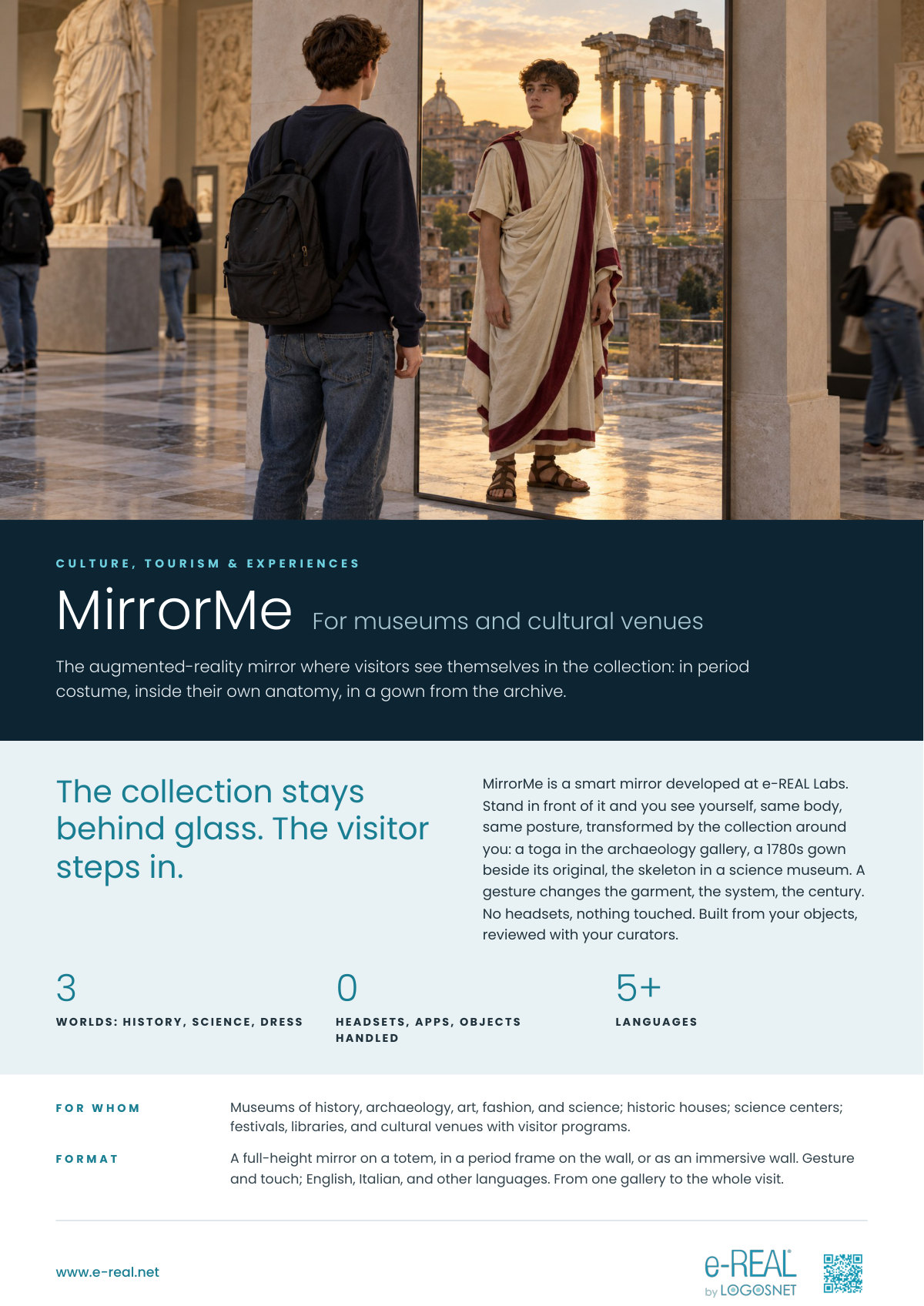
MirrorMe is a smart mirror developed at e-REAL Labs. In front of it, visitors see their own reflection, same body, same posture, transformed by the collection around them: a toga in the archaeology gallery, a 1780s gown beside its original, the skeleton and muscles in a science museum. A gesture changes the garment, the anatomical system, the century. Nothing fragile leaves the case; no headsets, no app. Costumes, anatomical plates, and settings are built from your objects and sources and reviewed with your curators before opening.
Three worlds, one mirror. History, for history, archaeology, and art museums, historic houses, festivals: the visitor wears the period of the room. Science, for science centers and museums of natural history and of medicine: skeleton, muscles, nerves, circulation, and organs over the visitor’s own body, moving with it. Dress, for fashion, costume, and textile collections: a garment from the case reconstructed on a living body, construction readable.
Delivered as a totem in the gallery or the lobby, as a wall mirror in a period frame beside the case, or as an immersive wall for a whole group; no headsets. Gesture and touch; English, Italian, and other languages. From one gallery to the whole visit; objects, languages, figures, and limits agreed with the institution.
02 / How It Works
01
Choose from the collection
With your curators: the objects, figures, or anatomical systems of the room, and the sources that document them. Each is reconstructed from the object, its measurements, and its iconography.
02
Stand in front of the mirror
The visitor sees herself transformed, same body, same posture. A gesture changes the garment, the system, or the century; the setting changes behind her. Those waiting their turn watch and photograph.
03
Read what you see
Short prompts on the mirror and in the room lead from the reflection back to the object in the case: who could wear this, what bone is this, who made this dress. Four things to observe: the questions the reflection raises, dwell time at the case, comparison between visitors, accessibility for different audiences.
04
What changes for visitors
They stop, look at themselves, and talk to each other. They see the link between their own body and the object in the case. They take home a picture with the museum’s name and the object’s story, and share it. School groups have a place to start; your curators see which objects draw the questions.
Brochure
The brochure
MirrorMe — Museums and Cultural Venues
The collection stays behind glass. The visitor steps in.
Contact Us
Shall we start with one gallery?
Choose one room and the objects in it. We build the costumes, plates, or garments with your curators, install the mirror beside the cases, and the public meets it for a few weeks. Then we look together at the pictures taken, the questions asked, and which room comes next.