
Healthcare / Explore
Healthcare / Explore
From Simulation Data to Reflective Intelligence
Using real simulation data to support better debriefing, professional development, and safer care. Audio only or full multimodal capture. AI running on site: your data never leaves your institution.
01 / The Solution
Every simulation produces far more than a recording: voices, attention, team interaction, actions and timing, and, where appropriate, physiological signals. Almost all of it is lost by the time the debrief begins. e-REAL turns those streams into reflective intelligence: an AI running on your own infrastructure aligns them with the scenario timeline, highlights the moments worth exploring, and prepares a neutral question for each. It reads the data, not the person: nothing is scored, and the facilitator decides what to examine and leads the conversation.
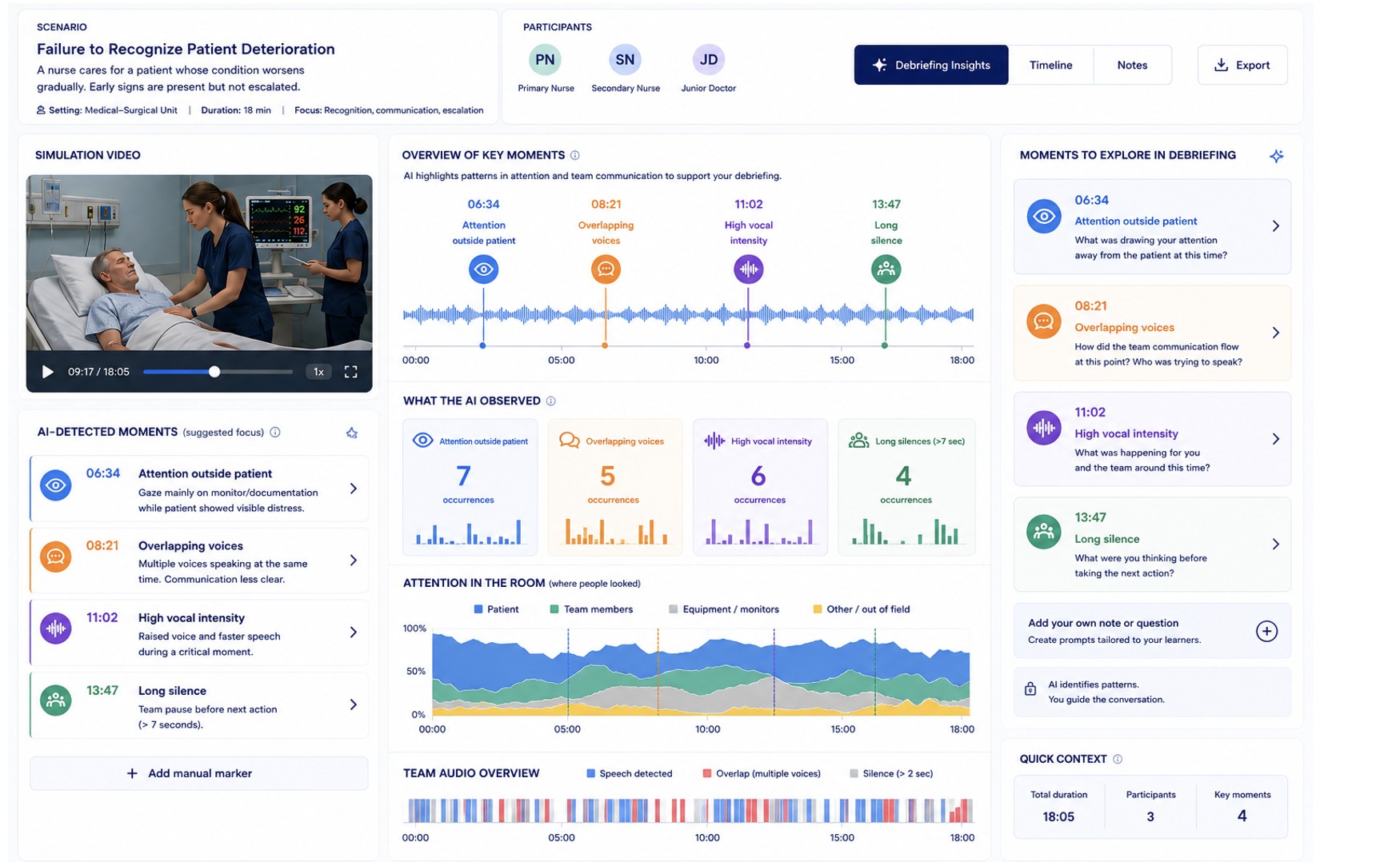
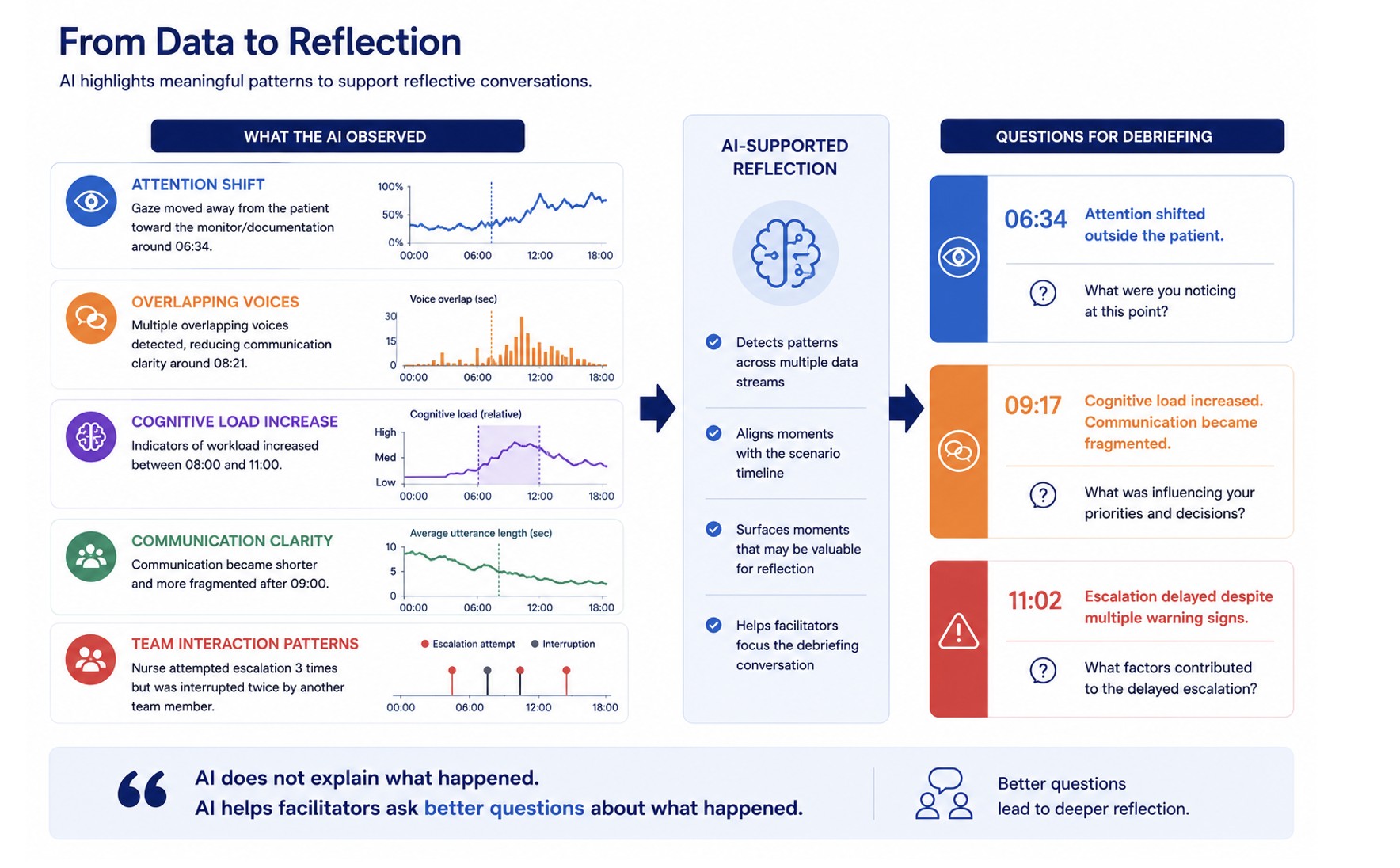
A richer view of what happens. Observers see a fraction of what a team does in eighteen minutes. Five streams are captured as the scenario unfolds. Voice: speaking rate, pauses, overlaps, interruptions, vocal intensity, utterance length. Attention: where gaze goes, between patient, monitor, documentation, and team. Team: who speaks, who interrupts, who stays silent, escalation attempts. Actions: protocol items done, delayed, or omitted, with timestamps. Body, optional: heart rate, HRV, arousal, cognitive-load indicators. Minutes after the scenario, the dashboard shows the moments that stand out on the timeline: attention outside the patient, overlapping voices, high vocal intensity, a long silence before the next action. Each comes with a neutral prompt for the facilitator: what was drawing your attention away from the patient at this time?
Deeper conversations, with evidence. With the moment on screen, the debrief moves from impressions to reasoning: learners explain their frame, compare alternatives, and decide what to do differently. Aggregated across cohorts and stations, the same data give educators and governance evidence they can act on. Equipment, by level. Level 1, audio: ceiling or table microphones, nothing worn, no cameras. Level 2, audio and video: the cameras you already have, plus an optional screen-mounted or wearable eye tracker. Level 3, augments: a chest strap or wrist wearable for heart rate and HRV, optional facial-expression analysis from video. Any browser, local AI appliance, no cloud. Processing on site: recordings, transcripts, signals, and analytics stay in your network. Signals are indicators, not verdicts.
02 / How It Works
01
Simulation
Realistic scenarios with manikins, standardized patients, or conversational avatars; real teams, real behavior. The AI observes in the background, on site, without changing how you run the room.
02
Multimodal data
Voice, visual attention, team interaction, actions and timing, physiological signals where enabled. Each stream is aligned with the scenario timeline and with your protocol items, so every signal has a time and a context.
03
AI-supported reflection
The system marks the moments that stand out, counts how often they recur, maps where attention went and who spoke over whom, and prepares one question per moment: evidence for the facilitator, never a score for the learner.
04
Deeper conversations
The facilitator chooses the moments that matter for the learning goals and asks, within PEARLS, advocacy-inquiry, or your own framework. Learners reason aloud, the team compares alternatives, and the debrief ends with decisions.
03 / What the Debriefer Sees
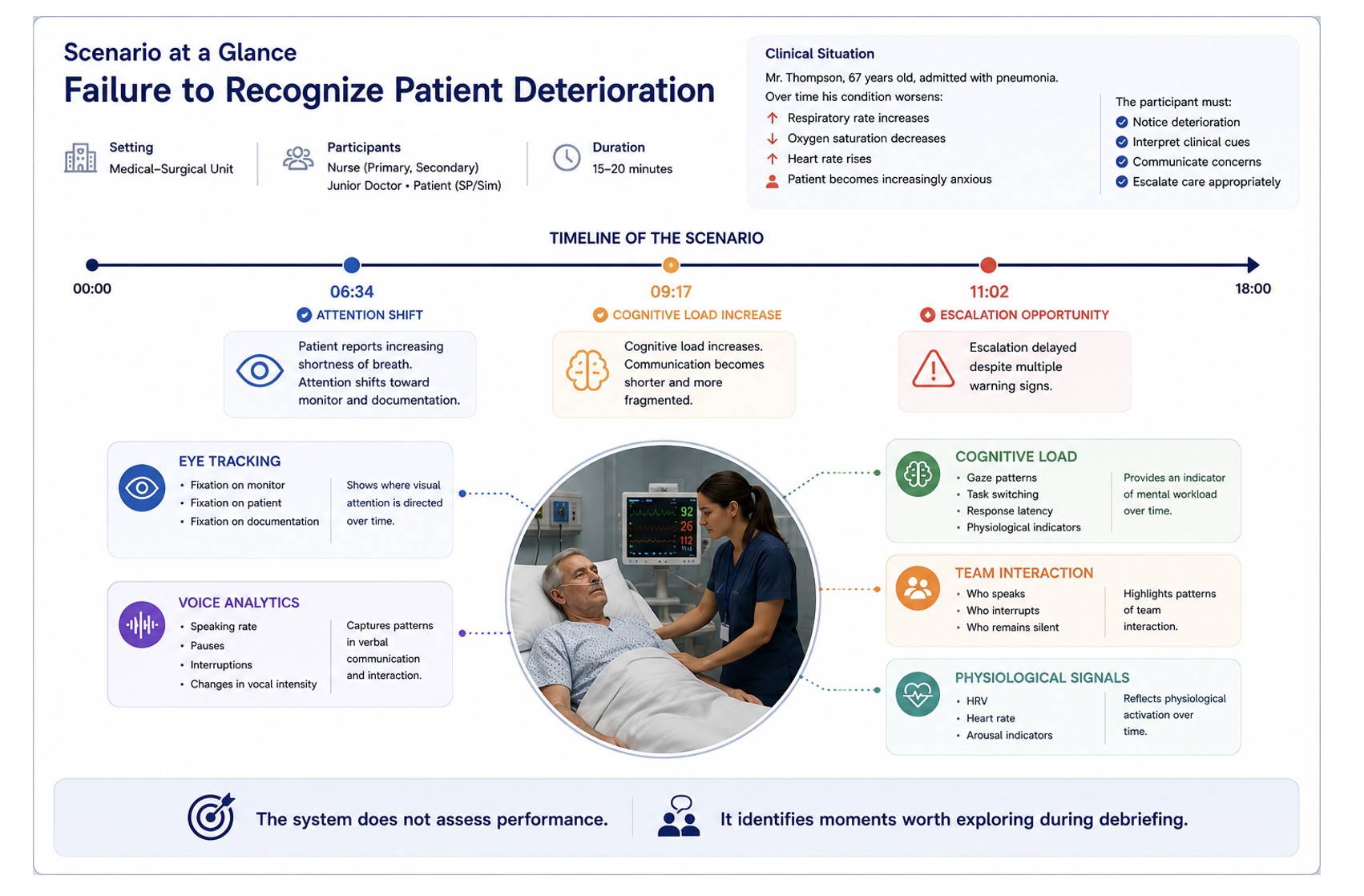
One scenario your center already runs, such as failure to recognize patient deterioration. The scenario sheet sets the clinical situation, the participants, and what the team must notice, interpret, communicate, and escalate. During the run, the AI observes: attention, voice, team interaction, cognitive load, and physiological signals where enabled.
Minutes after the scenario, the debriefing dashboard is ready: the video aligned with the timeline, the key moments the AI detected, how often each pattern recurred, where attention went, who spoke, over whom, and when the team fell silent. On the right, one neutral question per moment, to use, adapt, or discard. The facilitator adds notes and markers; nothing is scored.
04 / What Sets It Apart
Analytics in simulation debriefing usually mean a chart of who spoke and where people stood, read by a facilitator who has to decode it on the spot. Learners find such views objective and useful, but also hard to read, limited to the team level, and dependent on equipment that is easy to get wrong. e-REAL was designed around those limits.
Content, not just talk time
Voice detection tells you who spoke and for how long. We add what was said, vocal intensity, overlaps, interruptions, and escalation attempts, time-stamped on the scenario.
Attention and actions, too
Where gaze went, between patient, monitor, documentation, and team; protocol items done, delayed, or omitted. The picture is multimodal, not audio and position alone.
Nothing to wear at Level 1
Room microphones, no lapel mics, no positioning tags, no cameras. Video, eye tracking, and wearables come later, as opt-in augments, with consent per signal.
Moments and questions, not heatmaps
Color gradients are hard to interpret in the moment. The facilitator receives time-stamped moments with one question each, ready to open the conversation.
Team and individual
Team-level views support collective reflection; with consent, per-learner timelines support individual growth. De-identified by default when shared beyond the session.
Reliability you can check
A validation pilot measures agreement between the AI’s moments and your instructors’ notes before you scale. Processing on site, no cloud, your data rules.
Built for the room you already have, the faculty you already trust, and the data rules you already follow.